cross-posted from: https://slrpnk.net/post/37619927
A battery usually hides its nastiest chemistry from view. Inside many rechargeable systems, useful energy moves through liquids that are strongly acidic, alkaline, flammable, corrosive, or difficult to discard. The battery works, until the same chemistry that made it powerful begins to eat away at its parts.
A team in China and Hong Kong has now built a very different kind of battery. Its electrolyte is a neutral water-based solution of magnesium and calcium salts, chemically close to the brines used to coagulate tofu. In tests, the device ran for 120,000 charge cycles, used nonflammable ingredients, and met several disposal safety standards, the researchers in China report.
It is not ready to replace the battery in your phone. But it points toward a cleaner kind of battery for the place where longevity matters most: the electric grid.
the electrode retained 72.67% of its capacity after 120,000 charge cycles MgCl2 and CaCl2 Hex-TADD-COP, short for hexaketone-tetraaminodibenzo-p-dioxin covalent organic polymer. - the tricky part. 48.3 watt-hours per kilogram compare to LFP @90-160 Wh/kg
An aqueous battery using an electrolyte with a pH of 7 and suitable for direct environmental discard https://www.nature.com/articles/s41467-026-69384-2
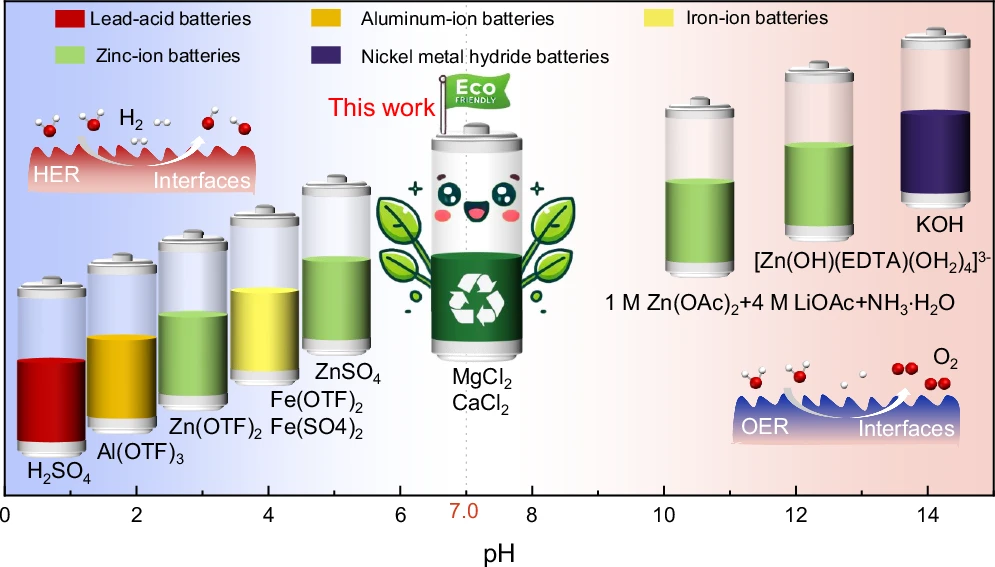
Appreciate the link! 48Wh/kg feels like it’s in the realm of being usable for some applications! And also sounds more environmentally friendly than other battery chemistries. And also helps diversify the mining/mineral needs for making batteries.
ETA: also omg they included that image in the article 🙂
use of water as a solvent limits maximum voltage
wanted to use water to get electricity anyway for a laugh? we have a tool for that: it’s called STEAM TURBINE
What is the problem with low voltage?
How high is that limit? 4.2V for lithium cells isn’t exactly stunning
4-5V is state of the art and pushing it there or beyond that gets very tricky very quickly. pure water has electrochemical window of 1.23V, but you can go a bit over that because at low overvoltage water splitting is slow at most electrode materials. that’s why lead battery can have 2V per cell and will generate hydrogen when charged much over nominal voltage
Doesn’t say what it’s input/output is, so maybe that’s the damper on this.
My new car runs on 65,000 lemons.
Exactly. If this could immediately solve the energy crisis, they’d be publishing the specs on this, and we’d all be making them in our kitchens this minute.
It’s just some sub-interesting science experiment, and the results it produced were unremarkable at best.
Not worth the click
So you’d only be interested in reading an article if it was going to instantly solve all of humanities energy problems overnight? Why bother clicking on any link with such ridiculously high standards?
I don’t think that’s what they are saying at all, but it doesn’t even mention how much power can go in, be sustained, and how much it can discharge. Those are the bare minimum details you’d want out of an article about a battery. The fact it mentions none of that is suspect.
Why would you think that?
In fact, why would you even bother trying to read my mind via a random Internet comment?
Why not read the article? smh. The “input” could be MgCl2 and CaCl2 in a covalent organic polymer (Hexaketone-tetraaminodibenzo-p-dioxin covalent organic polymers).
That is the STORAGE MEDIUM, and not the input or output, which would be the input power and output power. This is a battery.
Right, it’s a battery. It’s inputs are electrons, and it’s outputs are, yes, you guessed it, electrons. I guess I’m just not understanding your question. Would you care to clarify?
How fast can you shove those electrons in and how fast do you get them out?
Voltages, intake and discharge rates.
Another breakthrough technology that will mysteriously disappear & never come to market.
Exxon, Shell, or another massive battery patent owner will buy that tech and put it on lock down.
Nickel iron battery electrolyte solution is very easy to discard. Just water it down and put it on crops. It’s a fertilizer.
How is this oniony? Not the onion doesn’t mean any news from any source other than the onion.
Also, I feel like I see an article about a breakthrough in battery design every other day. I wonder if any of them will ever actually happen
How is this oniony?
Water-Based Battery That Could Last 300 Years Using Tofu Brine Ingredients
This is the bi-monthly “China invents earth shattering technology that we never hear about again” article.
Technological breakthroughs are almost always incremental. So learn to lie convincingly. Say, “lasts 25-30 years” not “300 years.”
some of you people itt have never imagined that there could be something like a research dead end and it shows