

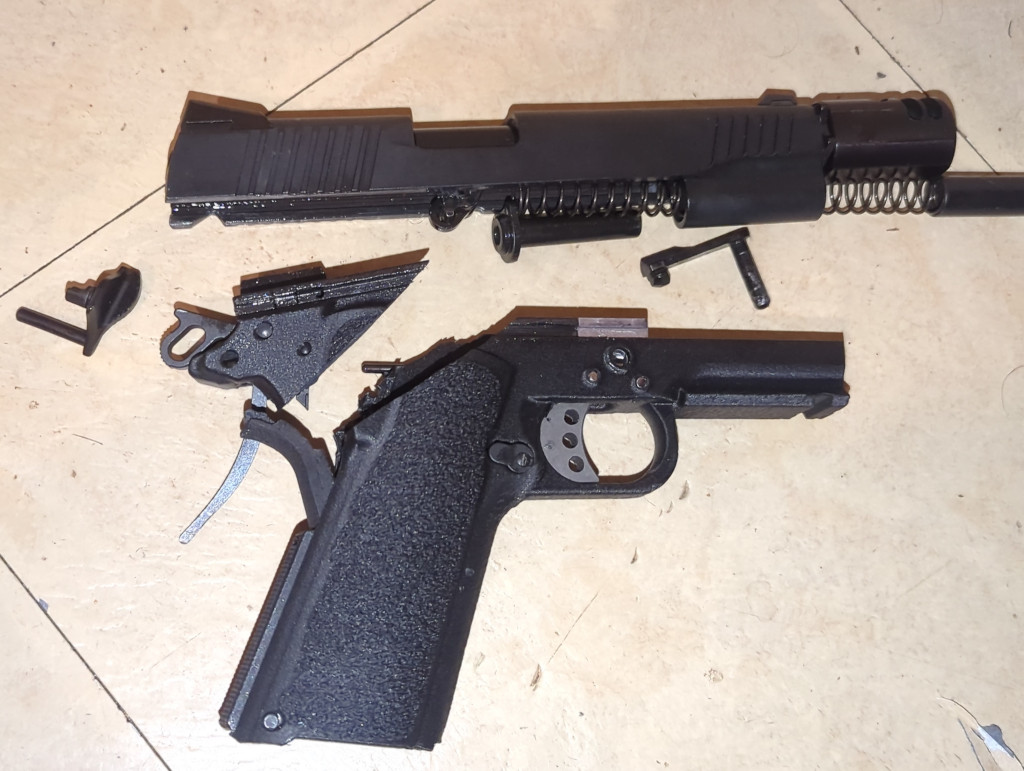
Bambu PET-CF printed with orientation to test layer strength. Results very similar to PA6-GF except PA6-GF breaks like glass, not on the layer lines. To be clear, it’s possible to use better orientations and custom model changes to reinforce things, I don’t consider that reliable though.
The 43X got around 6 shots before splitting apart. This is the 6th attempt with various filaments and models of 43X, they all suck. Using Aves rails. Might have buy the real thing.

The 1911 fired one single 45 and it’s done. Machined the rail myself 6061. First attempt. It’s too bad, this thing was so smooth.

I’m curious, is there a reason you went for 40c chamber temp instead of something hotter? I know when I print ASA or nylons I crank the heat up to the max for layer adhesion, but I’m not all that experienced with PETCF. I only printed a handguard with it and I was very unimpressed with how brittle it was (it cracked as I put it on my rifle), but now I’m wondering if my settings were wrong. I think I went with 320c nozzle, 100mm/s speed, and 65c chamber, so maybe the speed was too high or the temps were.
With my PET-CF/GF settings I’ve found that chamber temps over 40°C don’t improve layer adhesion. And running it much higher forces me to boost the cooling on bridges and overhangs, resulting in worse layer adhesion for complex parts.
It’s definitely possible to print too hot. For Siraya PET-CF/GF, 320°C is within spec. For Polymaker it’s a little high and for Bambu it’s a lot high. I generally don’t go over the recommended max without quantitative strength tests showing it actually helps. I’d also suggest dropping speed by 30 - 40% and doing some flow ratio calibration tests. Nothing kills layer adhesion like under-extrusion.
All that said, PET-CF/GF does have some significant limitations. It is extremely brittle and won’t tolerate any significant flexing or bending. Getting good layer adhesion doesn’t change that, it just means the break will be less uniform. For parts that need some flex (like an AR style handguard that clamps to a barrel nut) PET-CF/GF is generally a poor choice.
Cool, thanks for the advice. I was running Siraya so it was just at the high end of manufacturer recs, but your point about cooling on bridges in a hotter chamber is very sensible.
I think my problem was that I expected something more Nylon-y in terms of flex since that’s my only frame of reference with engineering filaments, so a handguard like I printed isn’t the right application for this stuff. I was just focused on thermal properties, since it’s a handguard for an RDB, where the pins holding it in place get notoriously hot because it’s right up against the gas block, and I didn’t account for the need to flex.
What sort of things would you say this filament is good for?
In the firearm space, PET-CF works well for some handguards that are bolt-in-place designs (I used it for the handguard on my Urutau). The high-stiffness, low-creep, low-cost is also good for magazine bodies (as long as they don’t need to survive drops). Stocks and braces are another application where PET-CF shines, again due to high-stiffness and low-cost. If you ignore cost, PET-CF/GF is always a bad choice. But if the idea of paying $60+/kg to print a pistol brace bothers you, PET-CF/GF at $35/kg starts to make more sense.