
• 3 Posts
  • 118 Comments
Joined 5 months ago
cake
Cake day: September 28th, 2025

help-circle
  • Since this isn’t a criminal prosecution, it wouldn’t fall under the Wyoming criminal defense statute. And since civil cases brought by CA would appeal to the circuit in which they are filed (9th Circuit), there’s no circuit court advantage unless someone in Wyoming decides to initiate a suit against CA. And even then there’s no guarantee the final resolution would come out of the 10th Circuit. Look what happened with NJ’s refusal to release Defense Distributed v. NJ back to the 5th Circuit despite a 5th Circuit court order to do so.

    Surprisingly, having these cases in the 9th Circuit could actually be advantageous since Bernstein v. US actually resulted in a 9th Circuit opinion that computer code is a form of 1st Amendment protected speech. That’s not to say that the 9th can’t overrule their own precedents … but doing so (hopefully) creates a higher burden.


  • Ok, I didn’t get that at all from your question.

    The Redman’s liner from Brownell’s is 7.94mm so a printed sleeve designed for 8mm should work fine with it. The Chaszel liner is ~9.5mm. You don’t need someone to make a custom model – just use your slicer to put a 9.7mm dia negative cylinder in the center of the existing sleeve STL and that should open it up enough for a Chaszel liner.
  • Chaszel is a specific maker of barrel liners. You can order direct from their website: https://chaszel.com/

    Brownell’s sells Redman’s 22 liner. It looks like they have 25" 22LR liners in stock. You’ll have to cut that down to the required length. You can get pre-cut Redman’s (or at least it matches Redman’s dimensions) 22 liner in various lengths from https://print-a-22.com/

    Note that the Chaszel and Redman’s liners are not interchangeable. Chaszel has an OD of 3/8" and Redman’s is 5/16". I don’t know which the Null 22 is designed for – check the docs.


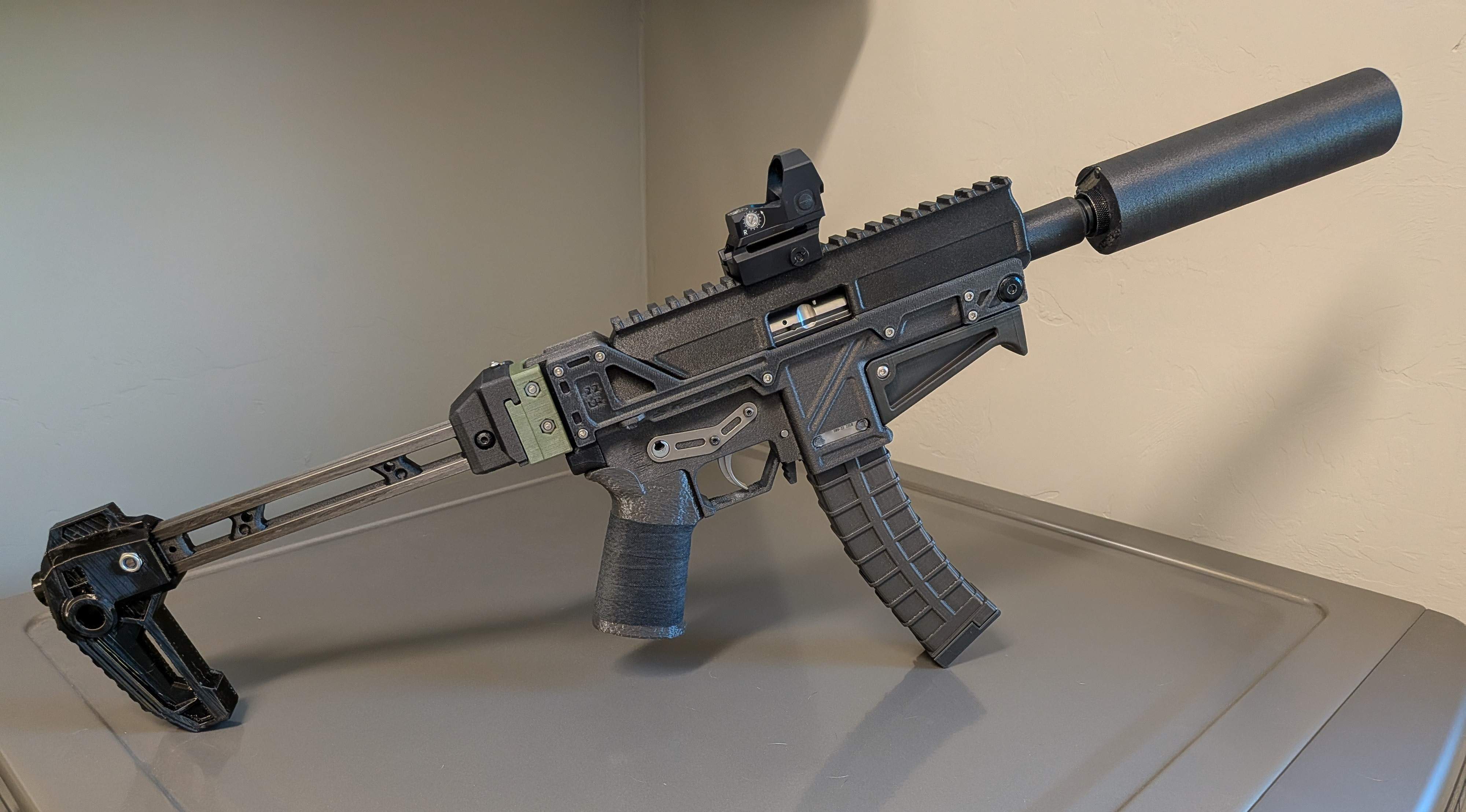
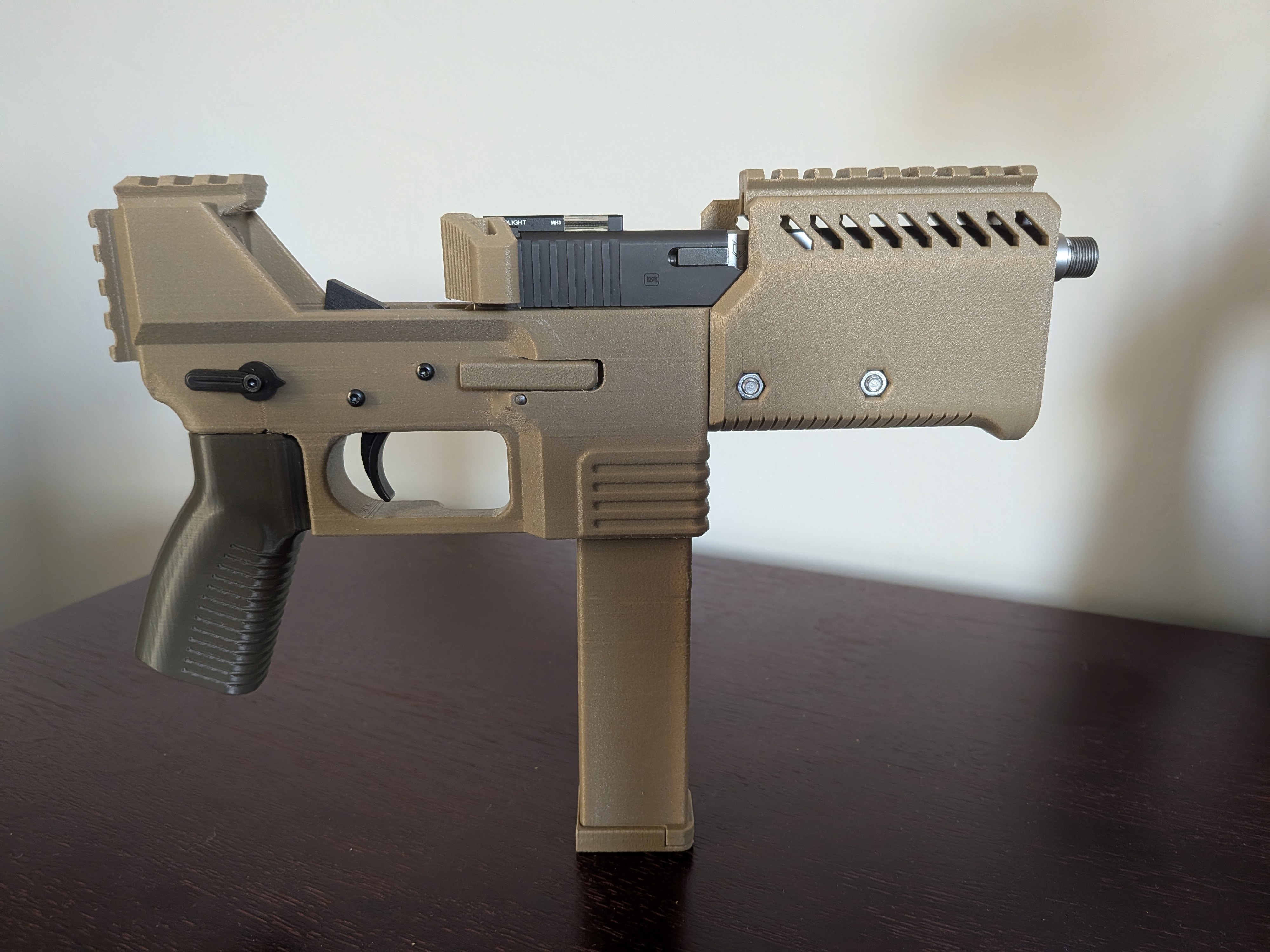
  • Quite a few designs are already approved. If what you want is in the dropdown list, you don’t need much for documentation. I form 1’d a DB9-22 and just put in the description that it was the same lower as the DB9 Alloy (already in the approved list) but with a 22LR upper receiver and barrel. I included a rendering of the lower with an arrow showing where I would put the registration info and that was good enough for a 10 day approval.


  • Anti-walk (really, anti-rotation) pins are of dubious value for a milspec receiver. The idea is that you want the hammer and trigger to rotate on their pins, but friction can cause the whole pin to rotate. That puts wear on the pin holes in the receiver, which really can’t be fixed without going to oversize pins. But this is really a tens of thousands of rounds with no lube kind of problem, so not relevant for most recreational shooters.

    But for a printed receiver, the stamped steel “dogbone” plate takes some of the stress off the receiver pin holes. The hammer spring is constantly pushing the hammer pin away from the trigger pin. Tying them together with a metal plate helps prevent creep (which is the result of a constant stress over an extended period of time).

    None of the Amazon offerings are particularly high quality. But most 3D printed guns aren’t duty-grade or precision competition guns. I’ve used an assortment of Chinese anti-walk pins and they’ve all been “good enough”.


  • If time is money, then something like the SUNLU E2 may be a good investment. It’s expensive, but will do the job with the least amount of fuss. An air fryer is probably the best cost/effort compromise (note that the less expensive models may need to be manually restarted every couple hours). If you have a basic understanding of electrical wiring and you don’t mind investing a little labor in modifications, a cheap toaster oven and a PID controller is the least expensive option (well under $50).


  • Creep test results I’ve seen show little difference between Sunlu PA6 and PA12 (both are quite good). I don’t have any trusted creep data for Polymaker PA612 (but I haven’t looked that hard).

    But you’re really overthinking it. If you’re getting good prints with Sunlu PA6-CF, use it - it’s more than good enough. Printed lowers aren’t going to last decades or 10s of thousands of rounds no matter what you do. There’s this “dream” that with the right material you can get a premium-quality lower. The reality is that the absolute best you can do is still miles below what you’d get with a $39 Anderson “poverty pony” (yeah, they’re $59 now that Anderson sold to Ruger - still cheaper than 1kg of Polymaker PA612).

    My recommendation is print your first one in PLA Pro and run it till it fails. When it does, reprint in something better (if you loved it), or print a different design in PLA Pro to see what that one is like. To mitigate creep skip the Hoffman bushings and get a set of anti-walk pins with the “dogbone” connectors (https://www.amazon.com/GLKTRS-Prevent-Rotation-Precision-Motorcycle/dp/B0D9XBCTQG). Or use a drop-in cartridge trigger (cheap milspec triggers suck and you’ll eventually want to upgrade anyway). Don’t be afraid to iterate. That’s the true joy of 3D2A … being to try out lots of interesting stuff without a huge expense.


  • That Hoffman video was a huge setback to 3D firearm material knowledge. He’s a smart guy with excellent design skills, but when you see statements like “PLA Pro … is not known to have any significant levels of creep …” which are provably incorrect, you have to be very skeptical of everything else he claims. The paper he wrote to accompany the article “looks” like an academic research paper but would be laughed out of a real academic peer review.

    The AR lower failure he demonstrates was caused by buffer tower flex, which leads to the buffer tube becoming misaligned with respect to the upper. When that happens the BCG binds up as it travels rearward. Imaging trying to push a straight bar through a bent tube. In his video, you can actually see the BCG getting stuck rearward. Hoffman does a piss-poor job of explaining that in the video.

    When it comes to creep, you can see huge differences across different brands of the same polymer. For example, Polymaker PA12-CF is known to be very high creep, while Sunlu PA12-CF exhibits even less creep than most PA6-CF brands. There are factors other than base polymer chemistry (in this case rate of crystallization) that can dramatically affect performance. For reasons unknown, Hoffman doesn’t get into any of that and that’s one more reason why his results should probably not be informing your material selection.


  • People really need to stop worrying so much about PA6-CF moisture absorption. Unless you’re going to store your build underwater, it’s just not a problem. At 5.3% moisture content (which you’re unlikely to reach even if you live on the gulf coast and store everything outdoors) the bending modulus of Fiberon PA6-CF is still 2286 MPa. That’s only 18% less than Polylite PLA Pro and 16% more than eSun PLA+.

    PA612-CF, PA12-CF and PPA-CF all have more than enough impact strength for an AR lower and will get you a little more stiffness. with PA612-CF and PA12-CF you may need to anneal to mitigate creep issues. PPA-CF needs higher print temps (up to 320°C) to achieve optimal strength which rules it out for some people. Builds in any of these materials will be slightly more susceptible to breakage due to drops or rough handling vs. moisture conditioned PA6-CF (though if that’s a serious concern, a $40 Anderson lower – if you can still find one – is probably a better choice than printing).


  • You really don’t need to provide much. In fact, too much info can actually slow things down since it’s more stuff for them to review. For suppressors, this section is very antiquated and didn’t anticipate 3D printing as a viable construction method. If you show you know what you’re making (there’s an actual design) and what you’re making it from, that’s really good enough.

    If the model is already in the selection list, that means the design as already been through “research” and approved on another Form 1. For my FTN.5 Rimfire that I submitted Jan 1, I just said I was building the design as released and identified the brand and type of filament. I uploaded an image of the filament from Siraya’s website as “documentation”. Approved in 10 days.

    When I did a Form 1 last year for a suppressor design not in the previously approved list, I loaded the STL into a viewer, turned up transparency so it showed the internal design, and saved that image. I annotated it to show how/where I would be applying the S/N and other NFA markings and submitted that as my documentation (along with filament info). That one went to “pending research” status and was approved in about two weeks.