

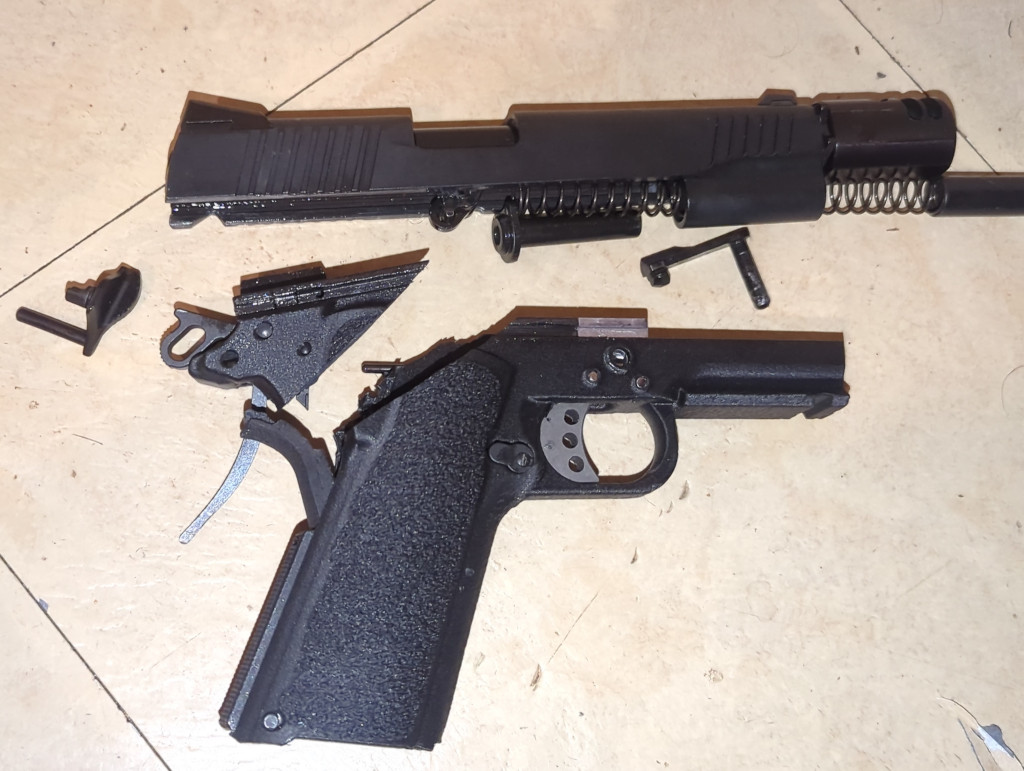
Bambu PET-CF printed with orientation to test layer strength. Results very similar to PA6-GF except PA6-GF breaks like glass, not on the layer lines. To be clear, it’s possible to use better orientations and custom model changes to reinforce things, I don’t consider that reliable though.
The 43X got around 6 shots before splitting apart. This is the 6th attempt with various filaments and models of 43X, they all suck. Using Aves rails. Might have buy the real thing.

The 1911 fired one single 45 and it’s done. Machined the rail myself 6061. First attempt. It’s too bad, this thing was so smooth.

I see, so if a .6 nozzle gets weaker at 1.4 at what point does a .4 nozzle get weak? Ive only used a .6 for nylons and used .300fdeblacks settings at .15
I use a .4 and .14 for a few frames and mags in PLA+ and ASA (only mags, not frame)
The first 5+ readmes said to use .14 height so I figured it was the norm
Read my comment again. 0.15 is not a magic number. A 0.6 nozzle gets weaker below 0.3, a 0.4 nozzle gets weaker below 0.2. The lower you go from there, the weaker it gets.
Readme files tell you what worked for the testers for that design. It isn’t necessarily the optimal strength setting. Sometimes you have to give up strength to solve other problems.
On printed mags, layer lines can be a source of friction so devs sometimes suggest a lower height to get smoother internal surfaces. It makes the print weaker, but often that’s ok.
People seem to want “universal settings” but 3D printing doesn’t work that way.