

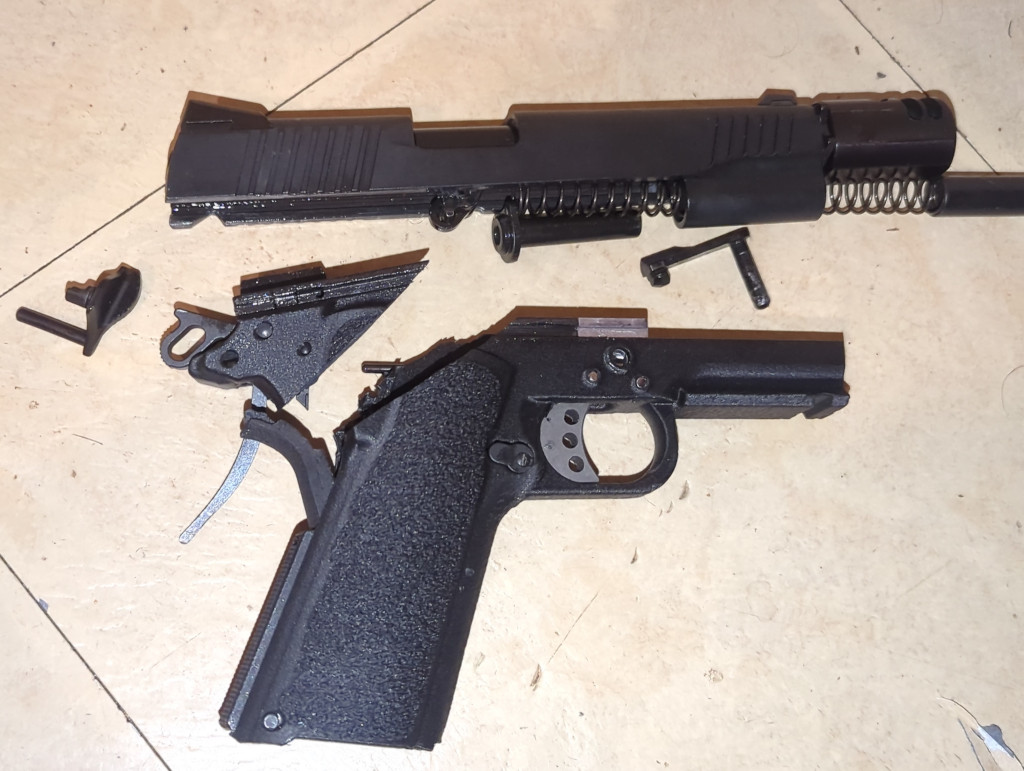
Bambu PET-CF printed with orientation to test layer strength. Results very similar to PA6-GF except PA6-GF breaks like glass, not on the layer lines. To be clear, it’s possible to use better orientations and custom model changes to reinforce things, I don’t consider that reliable though.
The 43X got around 6 shots before splitting apart. This is the 6th attempt with various filaments and models of 43X, they all suck. Using Aves rails. Might have buy the real thing.

The 1911 fired one single 45 and it’s done. Machined the rail myself 6061. First attempt. It’s too bad, this thing was so smooth.

Please read my post again. It’s on purpose. I’ve been 3D printing for almost 20 years.
I do run about 300C with a heated enclosure. 0.12 layer height and I run slower for maximum strength.
I have PET-CF G26’s and G19’s too, printed horizontally and they’re “fine” for sometimes thousands of rounds, until they’re not. The layer adhesion sucks. It’s only a matter of it getting hit the wrong way. I’ve dropped a G19 on the concrete and it split down the horizontal layers even though it was well over 1000 rounds without issue. The G26/G19 designs are much more robust designs for 3D printing. The G43 designs are way too thin and the Boomer also.
For the G43X I’ve tried PET-CF, PET-GF, PA6-CF, PA6-CG, PLA, straight PA6. The PLA is the only one that holds together… until it gets hot. I use all the brands, Bambu, Polymaker, eSun, etc. There just isn’t any way I can find to make that design work reliably in a 3D print.
The Boomer was just my first attempt but I was already thinking the design is thinner than it could be. I’ll be trying other materials but don’t have much hope. I’ll do aluminum or steel for my final version.
All of the “filled” filaments, CF, GF, etc are way more weak than the base material. It’s just what they are. The filler just helps prevent warping but everything else about it sucks.
Your loosing layer adhesion at anything lower than .15, but I do agree with you that pet-cf or gf sucks. It looks amazing when printed, but it doesn’t compare to pa-cf. So many people think that Hoffmans view on this stuff was the rising of Christ, but Hoffman was wrong and people can’t get over it. I really wish he would come out and recant his statement on pet-cf being better. Pa-cf works so good because of its elasticity, I’m sure you know this since you have been printing so long.
Sorry old comment, but is the lower than .15 only for nylons or is that for pla plus as well?
A few glock frames and mags said .14 so I figured it was the norm
True for all semi-crystaline polymers (PLA, PET, nylons, etc.). Generally speaking, around 50% of nozzle diameter is optimal. As you go down from that, the percentage of crystal boundaries aligning in the XY plane increases (weakening the material in the Z axis). As you go up from that, the loss of line contact area starts to negate the gains from improved crystal grain orientation.
I have not seen it tested for amorphous (non-crystalline) polymers like ABS/ASA, but most people aren’t using those for firearms prints these days.
Of course there are a lot of variables. For example, annealing can change the result as it alters the crystal grain. But unless you have test data that says otherwise, start at 50% of nozzle width and go down only as much as necessary to achieve acceptable Z axis detail.
I see, so if a .6 nozzle gets weaker at 1.4 at what point does a .4 nozzle get weak? Ive only used a .6 for nylons and used .300fdeblacks settings at .15
I use a .4 and .14 for a few frames and mags in PLA+ and ASA (only mags, not frame)
The first 5+ readmes said to use .14 height so I figured it was the norm
Read my comment again. 0.15 is not a magic number. A 0.6 nozzle gets weaker below 0.3, a 0.4 nozzle gets weaker below 0.2. The lower you go from there, the weaker it gets.
Readme files tell you what worked for the testers for that design. It isn’t necessarily the optimal strength setting. Sometimes you have to give up strength to solve other problems.
On printed mags, layer lines can be a source of friction so devs sometimes suggest a lower height to get smoother internal surfaces. It makes the print weaker, but often that’s ok.
People seem to want “universal settings” but 3D printing doesn’t work that way.
Wouldn’t humidity cause any frame In PA to eventually suffer enough creep to just fail?
See that’s where Hoffman has yall brain washed. No it won’t. It really takes heat and direct wetting to have that kind of failure.
Exactly this. I’ve suffered creep, but only on unannealed nylons, only over long periods of time (talking months to a year), and only in a case like the thin FCG cage of the SF5 lower where the hammer pin moved forward enough to cause binary fire with a slow trigger release. If you’re familiar with that particular failure, you understand that even a millimeter of misalignment can cause that to happen.
That gun’s super safe. So periods of high heat, high spring pressure, rapid movement, and thin walls came together to cause that failure.
In my experience, I’ve had some creep on my lowers due to moisture, but not to the point of failure, it also gets soft and can be bent by hand, funny cuz it returns right back to where it was and there is no issue except when you disassemble and it then no longer fits hahaha
Then again I live in the middle of a 80%+ RH rain forest
That’s good to know. I initially wanted to print PA6-CF, but was skeptical of longevity concerns. I also wouldn’t say he “brain washed” me. I was looking into it and first looked on Bambu’s website comparing the dry state and wet state, and the wet state bended significantly more than the dry one. I just assumed that would cause some sort of failure, especially since we’re putting external parts into a printed frame.
I didn’t mean that you were brain washed, I meant that there are so many that have strayed away from nylon and think that pet-cf is the way to go due to Hoffman posting his video. Don’t get me wrong, Hoffman is a great developer. However, I don’t think he put much testing into his theory on this. Pet-cf is great for mags and accessories.
Polymaker pa6gf25 has been great in my experiences, as long as its not annealed the filled nylons get quite brittle post anneal if my XD45 survives the weekend, it will be over 200 rounds on an un annealed frame
Moisture doesn’t cause creep. Moisture in PA6 reduces bending modulus and increases impact strength. Moisture in other nylons like PA12 doesn’t have much effect. In all cases, nylons only absorb a limited amount of moisture and don’t lose any more strength/stiffness beyond that point.
What was your conditioning process for any of the pa?
If they’re wet I blast dry for 8-10 hours at the recommended settings (typically 80C). I use heated vacuum drying as well. The print wouldn’t look like mine in the photos if the filament was wet.
Annealing can help with strength but the resulting dimensional changes usually screw everything up. There are certain techniques, tying, bracing, and/or very controlled temperature environments but it’s so much work for a result that still doesn’t quite make it.
Moisture conditioning.
It’s really cool that PA6 rings like aluminum when it’s bone dry, but it’s definitely not its most impact-resistant state.
I’m trying to see why he’s claiming only pla can survive. If he has 20 years of experience, I remember back in the day when everyone kept claiming pa6 was too weak to use yet nowadays it’s the complete opposite and seen as one of the best because the simple knowledge of water.